

The three-year CyberAgent project, which has reached nearly half a million Europeans, announces its conclusion. The European Union-funded initiative demonstrated that cyber resilience in small and medium-sized enterprises (SMEs) is built not only by implementing technologies but, above all, by providing necessary knowledge to the employees themselves. The training ecosystem developed during the project enabled the preparation of more than 400 internal cybersecurity change agents and achieved high women's inclusion rates.
Launched in 2023 and bringing together 8 partners from different countries, the CyberAgent project (funded by the ERASMUS-EDU-2022-PIALL-INNO program) addressed a pressing challenge: how to help SMEs protect themselves against growing digital threats. The project's answer: to train employees capable of identifying risks, sharing best practices, and shaping a secure digital culture within their organizations.
Practical Impact and Value Created
At the end of the project, the CyberAgent consortium presents results reflecting the broad scope of the initiative:
- Reached over 480,000 people, published more than 700 social media posts, and attracted over 1,200 followers and subscribers.
- Organized 6 seminars, attracting 736 participants, and participated in over 70 events.
- Engaged over 200 stakeholders in project activities.
- 425 participants successfully completed the pilot training and acquired practical knowledge, 38% of whom were women.
- Built a community of nearly 100 organizations, connecting 66 European SMEs, 26 cybersecurity organizations, and 7 service providers.
- Created 8 higher education and 8 vocational training programs, supplemented by open educational materials: 3,765 slides, 831 pages of text, 184 practical assignments, and 48 videos.
Focus on Women's Inclusion in Cybersecurity
One of the most significant achievements of CyberAgent is the promotion of inclusion in the cybersecurity sector. During the pilot training phase, women accounted for 38% of participants, and they made up 60% of the audience at project events. High program completion rates were recorded: 99% of participating women successfully completed the training. This confirms not only the quality of the learning model but also the importance of ensuring favorable conditions for entering the cybersecurity field.
Final Project Conference in Brussels
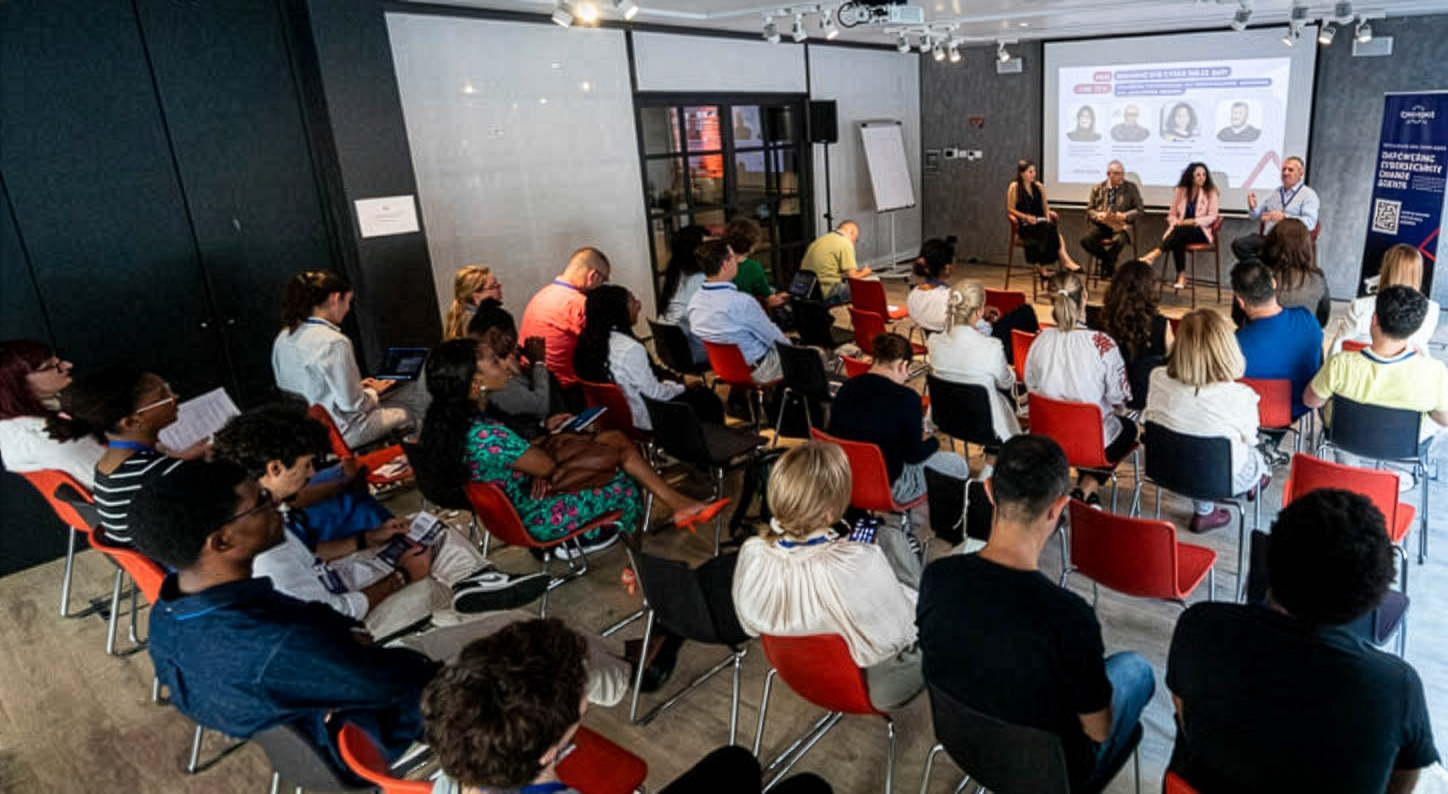
The project results, developed tools, and future guidelines were officially presented and discussed at the final CyberAgent conference, “Empowering Cybersecurity Change Agents,” which took place on May 27, 2026, in Brussels, Belgium. The event brought together 52 participants from 11 European countries, including SME representatives, higher education and vocational training experts, policymakers, and students. During the discussions, the main focus was on bridging the cybersecurity skills gap and promoting inclusion within the sector. To ensure that the developed infrastructure continues to successfully serve the European business and educational communities, the event featured a practical demonstration of the CyberAgent platform and an award ceremony for the winners of the cybersecurity competition.
Results Contributing to EU Policy Making
CyberAgent's results are relevant to policymakers working in the areas of digital resilience, skills development, and SME competitiveness. The initiative practically proves that cybersecurity capacities can be strengthened by empowering employees, students, lecturers, and SME staff to act as internal change agents.
Although the official project implementation phase has ended, the CyberAgent learning platform will remain active at https://platform.cyberagents.eu, and all methodological resources are available on the website www.cyberagents.eu. Educational institutions and organizations are invited to use these materials in their activities.
The consortium sincerely thanks all partners, experts, and training participants who helped turn the idea into a tangible and practical result across Europe.
The CyberAgent project has practically proven:
SMEs become more resilient to cyber threats when education meets real workplace needs and employees are equipped with practical knowledge.
Project Coordinator – Vilnius University Kaunas Faculty.
Dr. Renata Danielienė, Institute of Social Sciences and Applied Informatics.

Funded by the European Union. Views and opinions expressed are however those of the author(s) only and do not necessarily reflect those of the European Union or the European Education and Culture Executive Agency (EACEA). Neither the European Union nor EACEA can be held responsible for them.